



Invisalign vs. Braces: Which Is Right for You?
Clear aligners and braces both straighten teeth well. The right pick for you depends on your bite, your daily life, and your goals, not just on looks. Let's compare them.
February 18, 2026 · 6 min read
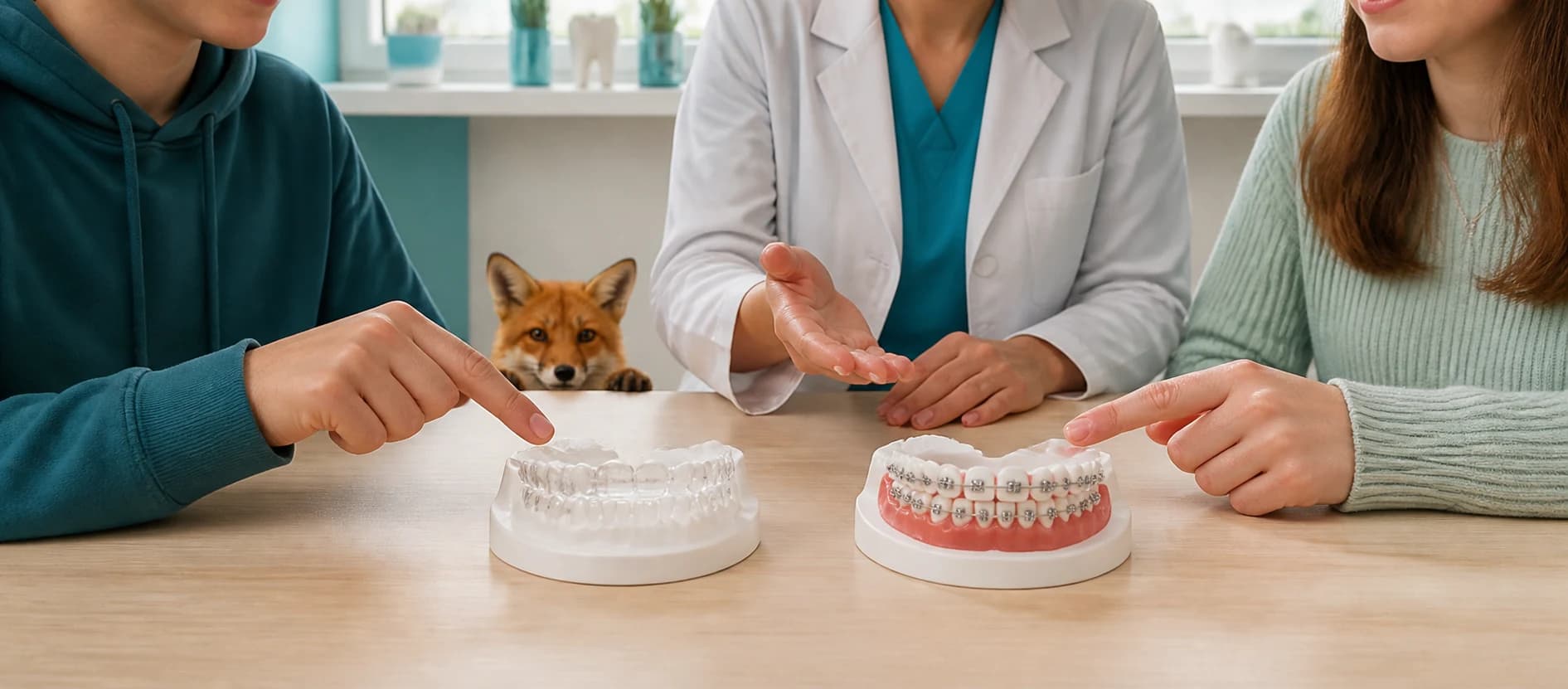
Two great tools, different jobs
Invisalign and braces do the same basic job: they use gentle, steady pressure to guide teeth into better spots. One isn't simply the right tool for everyone. The real question isn't which one is better. It's which one is the better fit for your teeth, your bite, and your everyday life.
Here's how they compare across the things patients in South Surrey and White Rock actually ask us about.
How Invisalign works
Invisalign uses a set of clear, custom-made trays. Each tray nudges your teeth a little closer to the goal, and you switch to the next set every week or two. They lift out, they're hard to spot, and they're planned on a computer from a 3D scan of your mouth.
The trade-off is sticking with it. Aligners only work while they're in, which means wearing them 20–22 hours a day. If you're happy to commit to that, they're a wonderful option. If you suspect they'll end up sitting in a drawer, braces may suit you better.
How braces work
Braces use small brackets stuck to each tooth and a wire that we adjust over time. They stay put, so they're working around the clock with no willpower needed. That makes them a steady, reliable choice for kids and teens, or for anyone who'd rather not keep track of trays.
Today's braces are smaller and more comfortable than the ones you might remember. And for tricky tooth movements, they give your dentist very precise control.
Comparing the two
Set side by side, the day-to-day differences come down to a handful of things.
- How it looks: Invisalign is hard to notice. Braces show more, though tooth-coloured options soften the look.
- Comfort: aligners have no wires to poke. Braces can rub a little, mostly in the early weeks.
- Eating: you take Invisalign out to eat anything. Braces come with a list of foods to skip.
- Cleaning: brushing and flossing are easy when the aligners pop out. Braces take more care to clean around.
- Sticking with it: braces don't rely on you remembering. Invisalign does.
- Tricky cases: big rotations and larger bite corrections sometimes do better with braces.
Cost and time
The two are often closer in price than people expect. Their fees tend to land in a similar range, depending on how complex the case is, so cost rarely comes down to one versus the other. For both, treatment time tends to fall between 12 and 24 months, though simple cases can finish much sooner.
Insurance usually treats them about the same, applying the same orthodontic benefit to either one. So price rarely has to be the deciding factor. The better fit for your teeth and your habits is what should lead.
How to choose
The honest way to decide is to have your teeth looked at. A quick scan and a bite check tell us whether your case is a clean fit for aligners or whether braces would get you a smoother result. We'll lay out both paths, with timelines and numbers, and let you choose with the full picture in front of you.
There's no wrong answer here, since both options lead to a healthier, straighter smile. We just want you in the one that fits your life, so you'll comfortably see it through to the end.